Pinterest Marketing for Construction Product Manufacturers: Strategies & Best Practices 2026
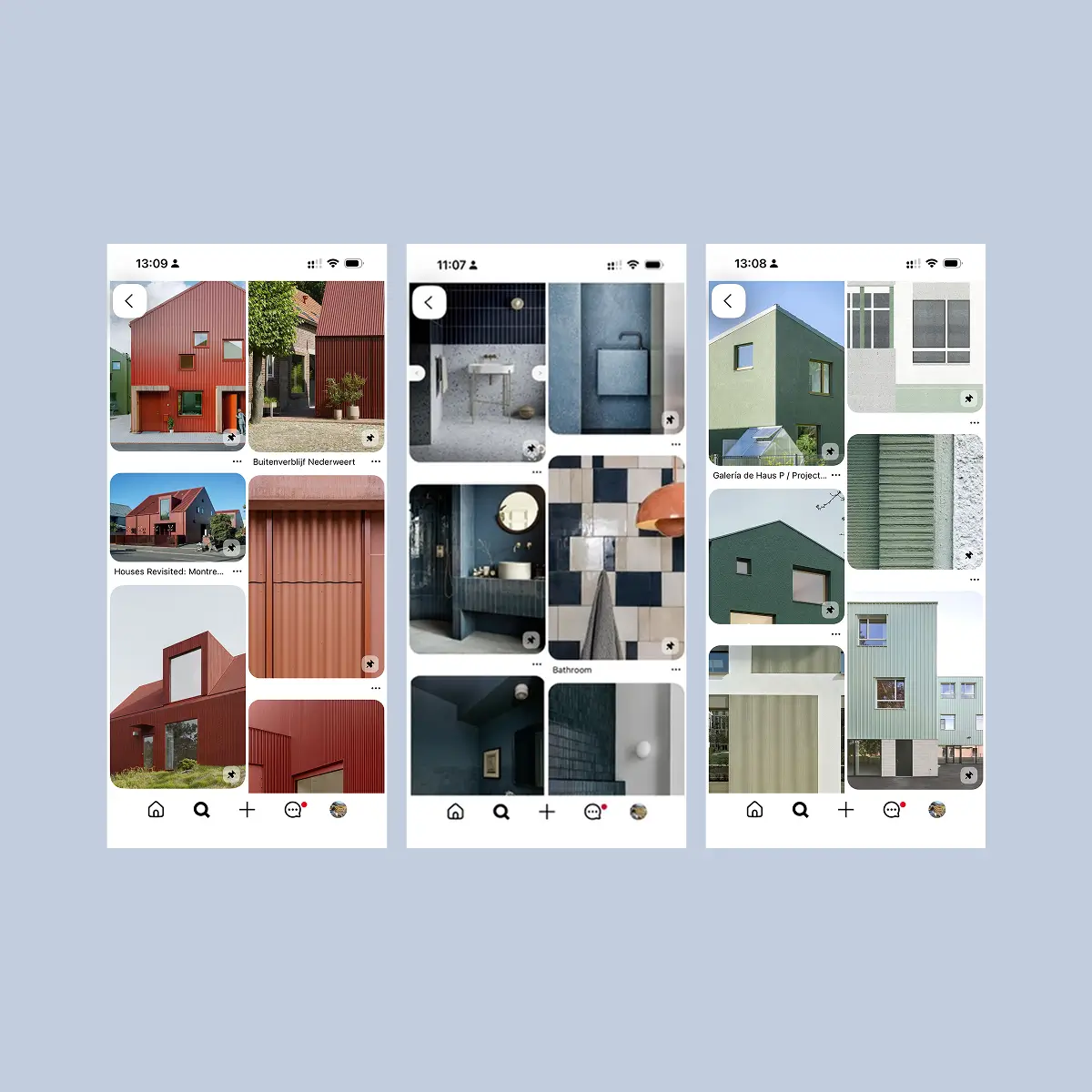
Pinterest still tends to feature only marginally in many building product manufacturers’ strategies. The platform is often viewed purely as a B2C channel or as a nice visual add-on to Instagram and the company’s own website. However, our project experience and numerous in-depth interviews – including with the hej.build architectural advisory board – paint a different picture. Pinterest has an impact early on. Namely, at the stage where images stick in the mind, preferences are formed and solutions are first sorted visually. For the commercial property sector, this very moment is crucial. In this article, we show what a successful Pinterest marketing strategy for building product manufacturers will look like in 2026.
Visual discovery rather than social media marketing: the unique logic behind Pinterest
Many marketing teams mistakenly classify Pinterest as a traditional social media platform. Yet Pinterest aptly describes itself as a ‘visual discovery engine’. Users come to the platform with a clear search intention. They are not primarily looking for brands, but for ideas, atmospheres and spatial concepts.
Pinterest is significantly less follower-driven than platforms such as Instagram, Facebook or LinkedIn. Whilst the home feed does display content from accounts you follow, the algorithm determines relevance primarily based on topic or keyword context and specific user signals.
One of the strongest signals of intent on Pinterest is the ‘Save’ (pinning a post to one’s own board). It is a key driver of organic reach and the long-term quality of content. A saved pin is considered helpful and remains visible on the board for the long term. Unlike the fleeting interactions in traditional social media marketing, a save is not a quick impulse but a sign of commitment. It’s someone’s way of saying: “I’ll keep this for later.”
»To me, Pinterest is like a huge supermarket of ideas.« Anni Rosenberg (wow tomorrow)
From an SEO perspective, this means that Pinterest largely operates on a search logic similar to that of a search engine like Google. Visibility is primarily achieved through relevance to search queries and through repeated saving.
To ensure that your content is actually perceived as relevant during this search process, various elements need to work together. This is because, in Pinterest marketing, relevance never arises in isolation, but only through the interplay of several factors:
- 📌 Pin and image (visual quality)
- 🏷 Title and description (SEO keywords)
- 🗂 Thematic context (relevance)
- 💾 Users’ saving habits
It is this interplay alone that determines whether content is shared or overlooked. Pinterest Ads can reinforce this logic, but they do not replace it. Paid ads work best on Pinterest when they blend organically into existing search and inspiration patterns (more on this below).
How target groups use the platform
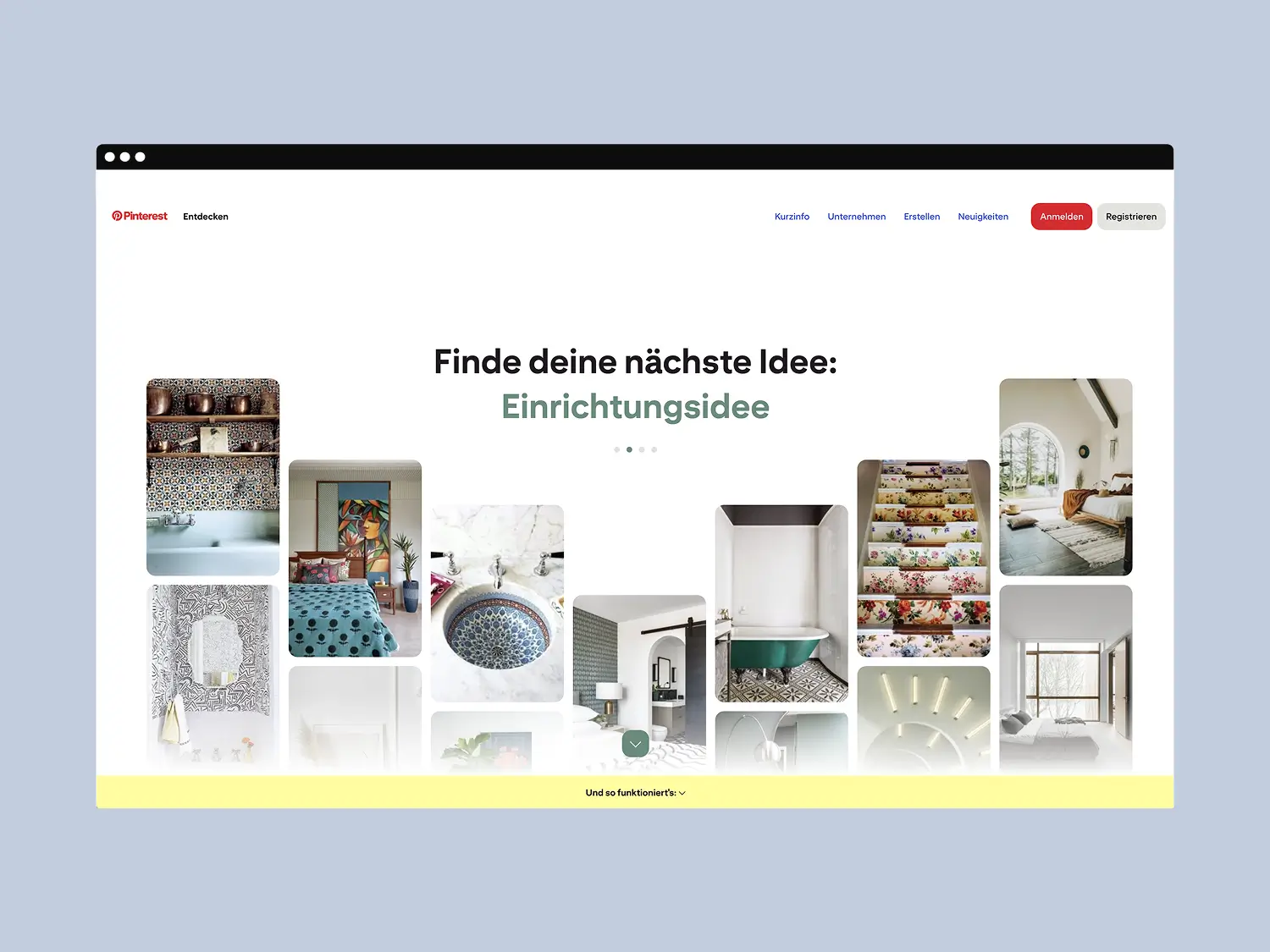
The fact that Pinterest is primarily used by consumers among the general public is no obstacle for manufacturers of building products – quite the contrary. For an optimal marketing strategy, it is crucial to recognise that B2B target groups, such as the (interior) architects described here, also make extensive use of the platform as a research tool. Pinterest thus serves as a central hub where professionals and end customers interact side by side. The focus must therefore be on tailoring content specifically to the professional needs of planners in order to establish a presence right from the early, crucial stages of a project.
Private individuals and end customers mainly use Pinterest on their mobile devices. They save images on the spur of the moment, compare lifestyle ideas and look for guidance on matters such as home décor decisions. The key factor is whether an image conveys a certain feeling. Text often plays a secondary role for this target group.
B2B target groups such as architects and interior designers work differently. They primarily use the platform on a desktop, often via shared office accounts. Files are saved in a targeted, project-specific manner. Pins serve as a visual database and are later incorporated into mood boards, presentations or internal decision-making documents. Neutrality is key in this context.
»We mainly use Pinterest in the early stages of project planning.« Anni Rosenberg (wow tomorrow)
Pinterest thus bridges the crucial gap between initial inspiration and concrete specifications: it is the place where architectural visions take visual shape – long before technical details or data sheets come into focus.
Marketing strategy: Is Pinterest worth it for building products?
A question many manufacturers of building products ask themselves: is it worth the effort if architects and interior designers aren’t specifically looking for manufacturers there?
The answer is a resounding yes, but with the right focus. Pinterest is no substitute for technical product communication. The platform comes into its own where projects begin: in the early stages of development, when images are being gathered and an initial sense of space, light and materials is taking shape.
Interior architects seek to create atmospheres, proportions and spatial effects. Images help to establish a direction, even before any technical specifications are finalised. It is only in the next step that the analysis begins: why does a room feel calm? Why does it appear open? This early phase is deliberately manufacturer-neutral.
»When we have a specific product in mind, we don’t search for it on Pinterest.« Laura Heidelauf (ACMS Architekten)
This is precisely where the potential lies for manufacturers of building products. Pinterest shapes which images, interior design ideas and design principles even enter the public consciousness. The translation of these into materials, structures and systems comes later. It is then that the companies enabling these effects come into focus. Pinterest rarely determines the final choice, but it has a massive influence on which solutions are present at an early stage – an essential component of the marketing mix.
Best practices for content and Pins: Our strategies as a Pinterest agency
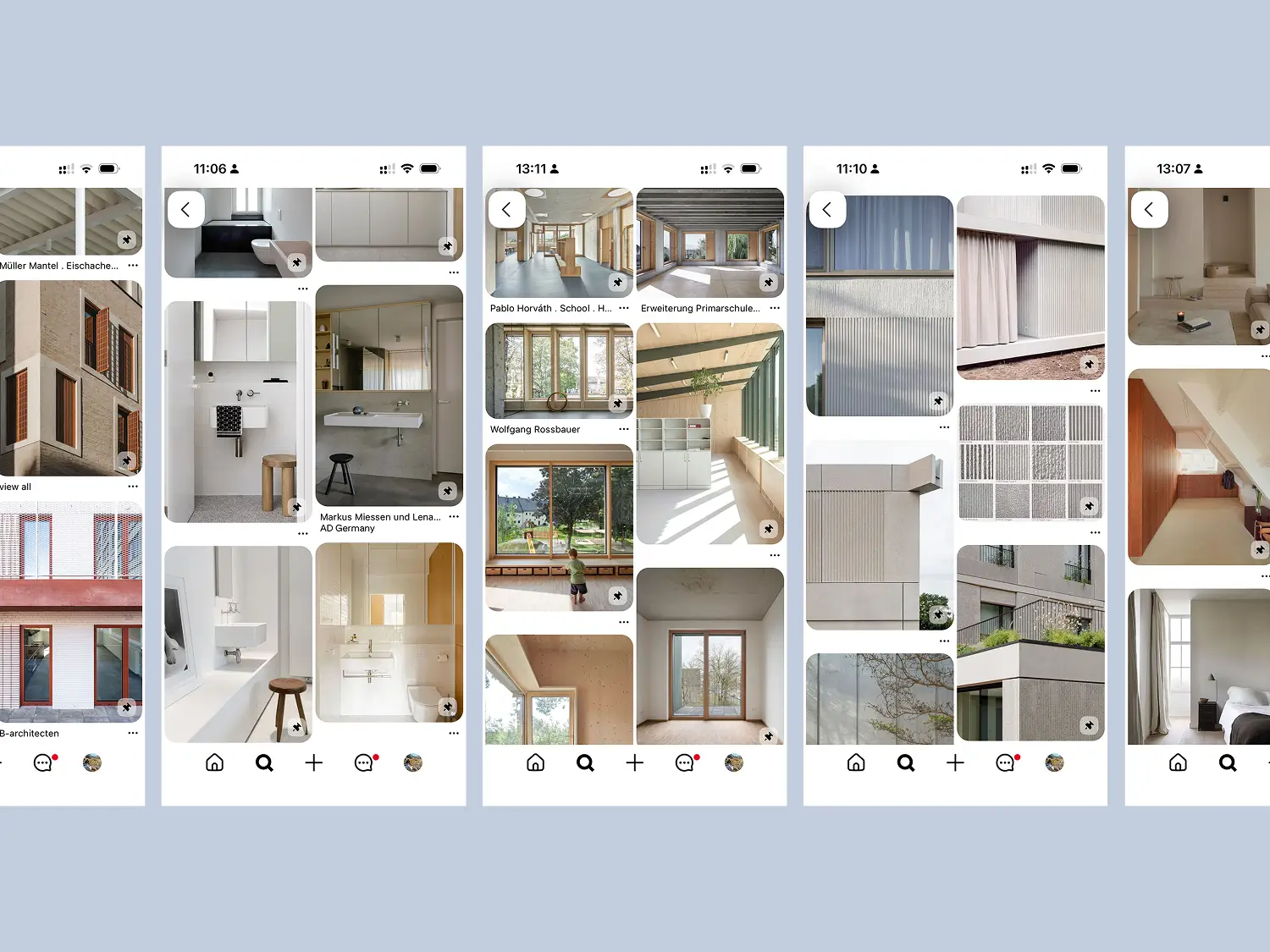
In our most recent projects as a specialist consultancy (and, in effect, an in-house Pinterest agency for our clients), certain recurring patterns have emerged. Content is saved more frequently when it shows products in a spatial context rather than in isolation. Images that convey a sense of materiality, scale and lighting generate more saves than simple product cut-outs.
Here are the key factors for the success of your content:
- 🧱 Space before product: Products perform significantly better when they form part of an architectural context (‘architecture’ as context). Designers seek solutions for spatial contexts, not for isolated components.
- 🧘 Visual calm: Minimalist imagery without visual clutter is more likely to be remembered. A clear, aesthetic visual language conveys professionalism and leaves the planner room to develop their own ideas.
- 📌 Curation over quantity: A carefully curated selection achieves greater reach per pin than a large volume of unstructured content. Quality trumps quantity – every pin should offer architectural value.
»I need peace and quiet when making a choice. Adverts or visual distractions ruin it completely.« Anke Stern (ankestern interior)
These patterns stem directly from the way users utilise Pinterest in a professional context.
Pinterest Ads: A boost for brand visibility in the commercial property sector
Whilst the organic strategy forms the foundation, Pinterest Ads (Promoted Pins) act as a catalyst. In the B2B context for construction products, they are particularly valuable as they appear in search results not as intrusive adverts, but as tailored solutions.
The key advantage is that Ad Pins saved by (interior) architects on their project boards remain as organic Pins even after the paid campaign has ended. This ‘long-tail’ effect ensures sustained reach that extends far beyond the original budget. Furthermore, ads enable precise keyword targeting, ensuring immediate top-of-the-page visibility for highly competitive terms such as ‘sustainable façade’ or ‘smart office design’.
From SEO to GEO: Pinterest in the age of AI search
Generative response systems (e.g. ChatGPT Search or Google AI Overviews) are becoming increasingly important as search interfaces and often utilise linked web sources. At the same time, Generative Engine Optimisation (GEO) is emerging as an approach to formatting content in such a way that it is better understood by these systems and cited more frequently as a source.
Pinterest is strategically exciting in 2026 for two reasons:
- As a platform itself, Pinterest relies heavily on context (image + title + description + themed boards) and user signals such as saves. This makes content extremely easy for algorithms to interpret.
- As an AI ecosystem: Pinterest trains its own GenAI systems, such as ‘Pinterest Canvas’, using pins, descriptions and metadata that users upload or save to the platform.
Those who maintain pins today with precise descriptions, a clear board structure and rich pin metadata will, above all, increase their discoverability within Pinterest – whilst also improving the chances of their content appearing as a referenceable web source in AI-powered search interfaces.
Measuring success: Which metrics matter?
Building product manufacturers often make the mistake of comparing Pinterest with the KPIs of Instagram or other traditional social media platforms. To assess the success of your marketing strategy, you should focus on the following metrics in Pinterest Analytics:
- Saves (save rate): One of the strongest indicators of intent. It shows that your product has become part of a mood board or planning process.
- Visibility in the Discovery context: Analyse impressions and saves by source (Search vs. Home Feed, etc.) as well as keyword clusters via Pinterest Trends. This will help you understand how deeply you are penetrating thematic search queries such as ‘facade design’ or ‘modern bathroom planning’.
- Outbound links: How many users move from inspiration to further exploration on your website? Note: Once the user reaches your site, tracking is handled by standard web analytics. Here, you should consider supplementary metrics such as dwell time and conversion rate (e.g. CAD downloads, sample orders or contact enquiries) to make a final assessment of the quality of the Pinterest traffic.

Your roadmap: 5 steps to a professional Pinterest presence
- Set up a business account: Use a verified profile and install the Pinterest tag for accurate tracking.
- Keyword research: Identify which terms interior designers actually search for in the early stages.
- Aesthetic check: Invest in high-quality architectural photography. Pinterest is a purely visual platform – image quality determines whether a post gets saved.
- Board structure: Create boards based on application areas (e.g. ‘Hospitality Design’) rather than just product categories.
- Consistency: Pinterest rewards regular activity. Plan your content in advance rather than uploading everything at once.
In short: Curious to find out what role Pinterest could play for your business?
Pinterest is not a direct sales channel. Pinterest is an early indicator of relevance in both B2B and B2C contexts and should be an integral part of any modern marketing strategy.
For manufacturers of building products, the key lies in understanding the early stages of research and planning. Anyone who treats Pinterest as just another social media channel is missing the point of the platform. Those who see Pinterest as a visual search engine position themselves right where projects begin.
At hej.build, we focus specifically on these early stages – through interviews, analyses and current projects with manufacturers of building products.
🤝 We’d be happy to discuss the potential that Pinterest holds for your brand.